
Donizetti Fall
I love u Gaetano

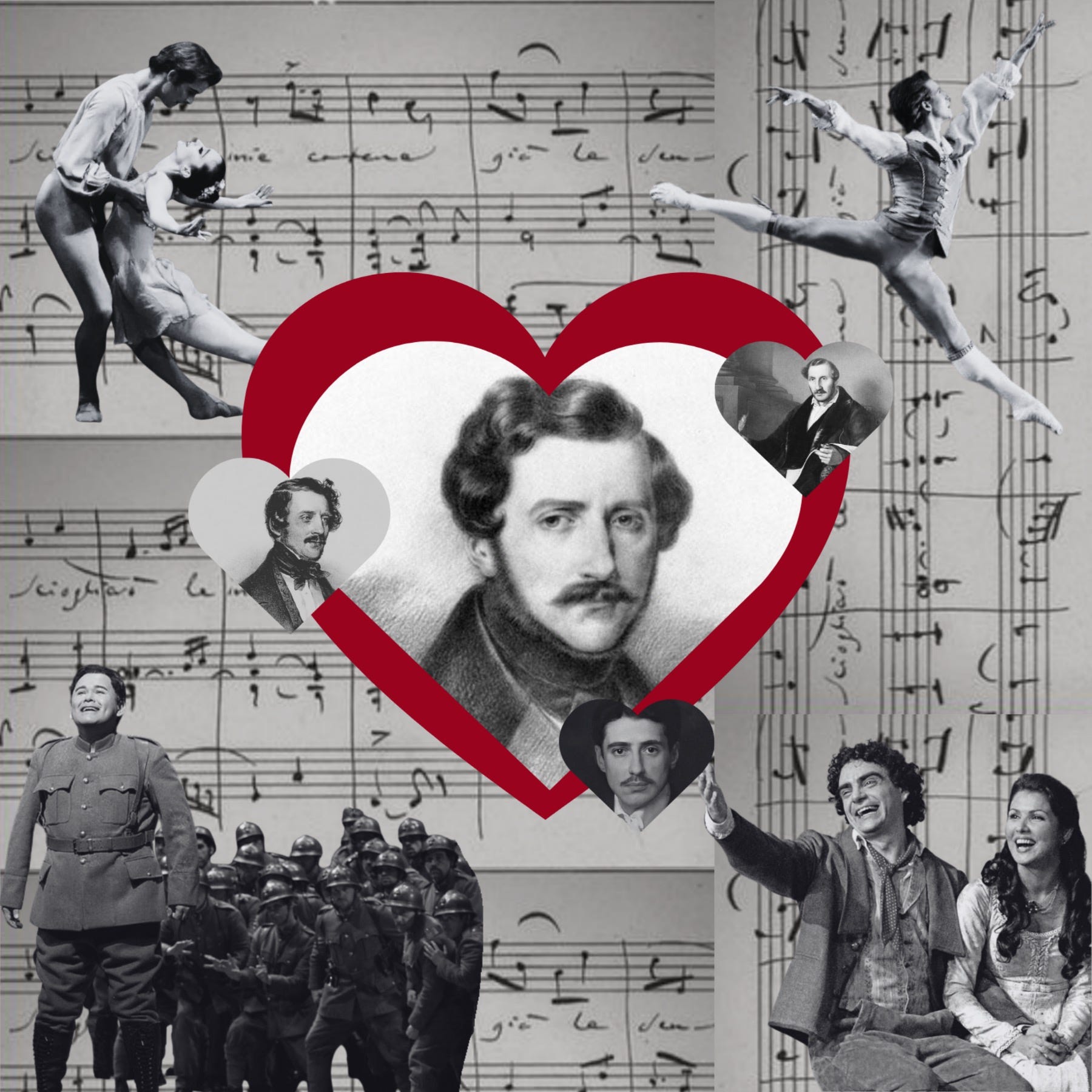
I was predestined for an emotional, all-consuming love affair with Gaetano Donizetti this Fall.
I’d just spent a lonely summer studying for the bar exam. As the days grew hotter my one solace became long evening walks listening to old episodes of the opera podcast, Aria Code. One such episode was about Donizetti’s L’Elisir D’Amore and the famous aria “Una Furtiva Lagrima.” My law-addled mind was this aria’s perfect victim. Already a sucker for the oboe, I was easily charmed by the opening melody and the soulful, pining sounds of the tenor.
“A furtive tear appeared in her eyes… She loves me, yes she loves me, I see it, I see it.”
This became the first song I turned on in the morning, its melody following me all day. But once my studying came to an end and I moved into full celebration mode, I left Donizetti behind. But he wasn’t done with me. I encountered him three times this fall, each time leaving me with a different, though equally powerful, impression.
Phase 1: Surprise.
In September I went to the ballet to see Balanchine I. I understood Balanchine I to be a showcase of three separate dance arrangements, each with its own plot (or lack thereof). The third, and most famous piece, was choreographer George Balanchine’s interpretation of Swan Lake. That was the reason I was there, and likely most of the audience too.
But, Balanchine I opens with variations from Donizetti’s Don Sébastien, a French opera of which I know absolutely nothing. I noted this before the day of the show. It was especially remarkable because I had tickets to see Donizetti’s La Fille du Regiment at the Met just one month later. I pointed this out to my cousin Maggie with whom I was to attend both the ballet and the opera. (Maggie also edits my substacks: Hi Maggie!).
“Lots of Donizetti this fall I said,” as we climbed the stairs to our seats in the high balcony.
As the curtain came up, the horns began to play a taps-like opening before the rest of the orchestra came in. Then, nine dancers came quickly on stage in three groups of three. They were colorfully dressed, as if for a spring party, and the light fabric of their clothes caught their air as they moved. The music was cheerful, and not unlike a sort of military march. While light and fun, I wasn’t called to this music in the way I was with my summer aria. Maybe it was too joyful, or not memorable enough. Shamefully, I found myself thinking forward to Swan Lake. But in a moment it all changed. The movement paused, until one dancer on the right began lilting about off beat. Then, a solitary trumpet began to ring out. My heart skipped a beat.
Shouldn’t love surprise you a little? Catch you off guard? The mournful solo melody of the trumpet brought me straight back to where I was this summer.
Phase 2: Pining.
Donizetti stayed with me through October. Over the summer I had developed a habit of listening to WQXR, New York’s classical music radio station, during the day. The music is beautiful, of course, but it is also a great tool for learning new pieces. But in October, WQXR hosted a weeks-long donation drive after Congress cut federal funding to public radio. I’m already a financial supporter, don’t get me wrong, but the result of this donation drive was they played significantly less music. I turned to Donizetti.
I listened to the Don Sébastien variations over and over, skipping ahead to the trumpet solo. Then, I went back to “Una Furtiva Lagrima.” And I realized that listening to the same aria wasn’t enough. I needed more. I spent October watching full-length Donizetti operas on Youtube. Switching back and forth between L’Elisir D’Amore and La Fille du Regiment, I watched the singers closely. After years of watching ant-sized performers from Family Circle, I was not prepared for the sharp pang of emotion that accompanies watching opera up close.
This feeling was especially strong for Anna Netrebko and Rolando Villazón, who starred in L’Elisir D’Amore at the Vienna Staatsoper in 2005. Given both singers’ notoriety, this version blankets the internet. My days began to fill up, watching Netrebko and Villazón. Rewinding to catch their expressions one more time, to hear the intricate harmonies. And I began to appreciate melodies other than Donizetti’s slow and sad love songs. I saw that the comedy and levity present throughout only made the pain of pining all the more beautiful. And it was with this mindset that I went into La Fille du Regiment at the Met.
Phase 3: A joyful farewell.
La Fille du Regiment drew large crowds this year, mainly because it starred Sandra Oh. Perhaps a bit of a gimmick, it has become common practice for productions of this opera to cast a celebrity for the one speaking-only role in the show. Whatever it takes to get people to the theater. I myself have been aware of this show because of another gimmick – the encore.
One of the most famous moments in this comedic opera is the tenor aria “Pour mon âme.” This piece is notable because to achieve it the tenor must hit nine consecutive high Cs. This is a feat for any singer, and in 2019 Javier Camarena did just that. Except he did it 18 times. In a rare showing for the Met Opera, Camarena sang an encore. And I am still so mad I wasn’t there. But this 2025 production was to be my redemption. Even without an encore, this whole show is filled with operatic gymnastics and vocal triumphs. And it did not disappoint. Tenor Lawrence Brownlee and soprano Erin Morely delivered some of the most exciting performances I’ve ever seen. You really have to be able to hit some high notes to be in this show.
While the music is phenomenal, I will say that in general comedic operas are not my speed. Perhaps the comedy of the 1840s just doesn’t speak to me. But even worse, for some reason they had the actors throw in English punchlines throughout – inexplicably in New York accents. Those jokes received guffaws from the audience, but just an eyebrow raise from me. This critique aside, I walked out of the theater feeling light and elated. My heart leapt at the nine high Cs, and this joyous feeling stayed with me until the end. Notwithstanding the bad jokes.
Still, La Fille du Regiment tempered the chaotic love I felt for Donizetti. Discovering a poor sense of humor can do that to a crush. But this was good, it was right to happen this way. We have to be clear-eyed about composers, just like our heroes. In any case, I’m glad I had this fall with Donizetti. It’s nice to know I can feel that way.